AI that remembers, and that you can see inside.
We are a small research lab working on memory and interpretability. We build Continuous Thought Machines in Rust, publish our test verdicts, misses included, and built the tracker we use to watch it all.
See the demos · Track your own runs
What we have measured.
Solves bigger mazes when given more ticks
Trained only on 11×11 mazes, a CTM that marks the path square by square (a simpler setup than the CTM paper's, which writes the route out as moves) solves 99.4% of new 11×11 mazes. A plain recurrent network that is not a CTM does that too. The CTM's edge is on bigger mazes, and it is modest: with the same budget for both, 4 ticks per side, it marks the exact path in 71% of 25×25 and 50% of 33×33 mazes, against 67% and 37% for that network. Walking the path it marks, it solves 89% and 77%, and 93% and 81% at 160 ticks, the most we tested (mean of 3 training seeds).
Learns what to remember
Given 32 bytes per chess game, a small trained encoder recalls who played a position 26–27 points more often than random codes of the same size, picking among 8 players. It works on positions far from anything a raw-board memory keeps. The demo asks a different question, naming the one game out of 10,000, so its numbers differ.
Records every neuron, checkpoint by checkpoint
Our neuron export records, for every neuron of a CTM at every saved checkpoint, the inputs that push it up and down. With it we tested a claim from Goodfire's essay “Neural Networks Are Already Clean”: that a neuron grows outward from what it already responds to. In two chess training runs it did not, by our pre-registered bar. We don't claim to know what the neurons compute yet. In our development SDK, not published yet.
Read the tests and their verdicts
We publish the misses too.
The tests behind this site's claims are pre-registered: the question, the bar and the verdict rule are written down before the run. Then we publish the verdict, NO included. Several of our ideas failed that way, and the results page says so.
Track your own runs.
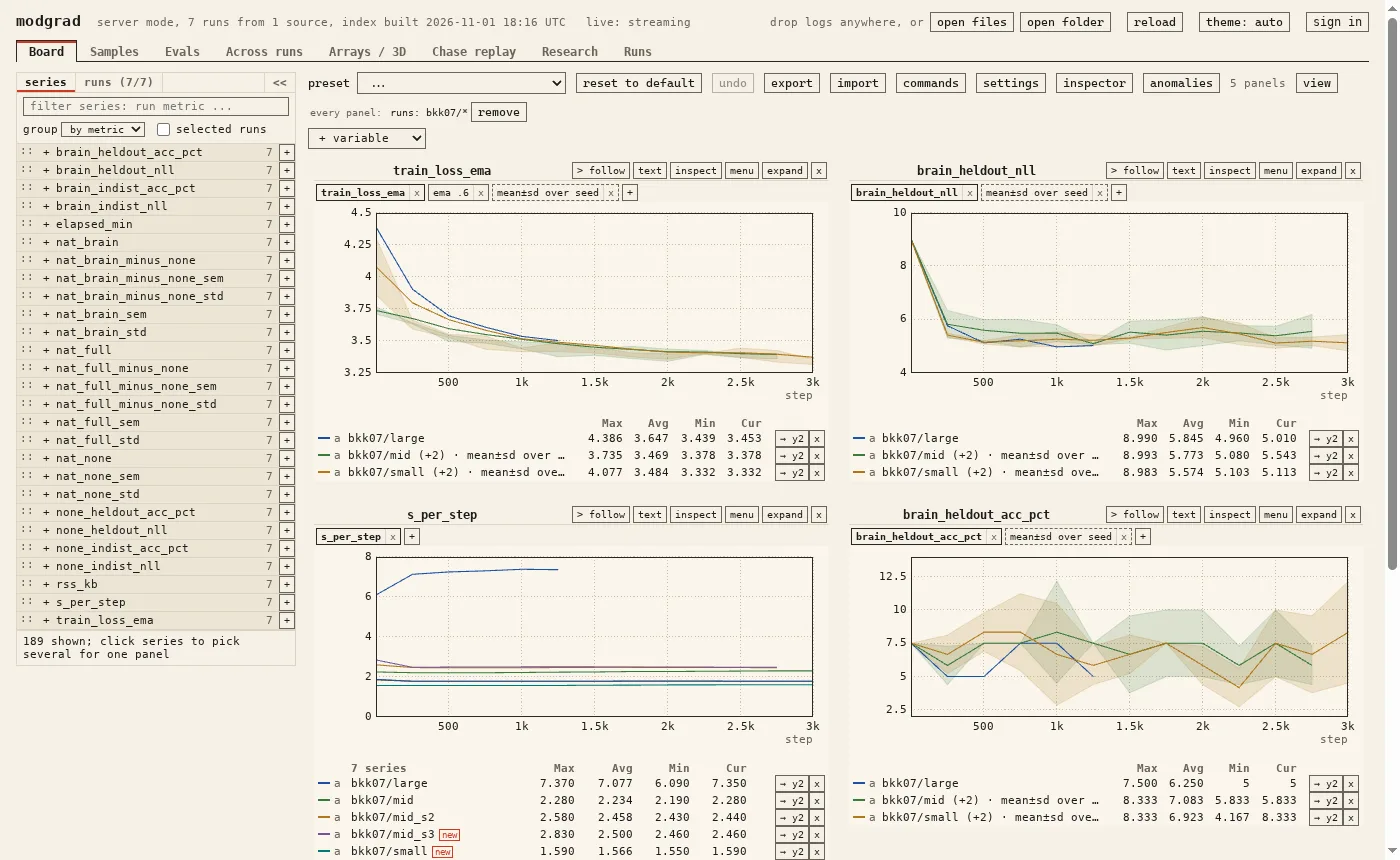
The tracker we built for our research is free to use. Keep using wandb: point it here and watch the board update live. No signup to start.
1. Press Start tracking. You get a board, its project name and a token. Start tracking
2. Run your script with them:
export WANDB_BASE_URL=https://app.modgrad.com
export WANDB_API_KEY=<token>
export WANDB_PROJECT=<project>
python train.py
If your script passes project= to wandb.init(), remove it: a token writes to one project.
- wandb The unmodified Python package. 25 compatibility tests, all passing.
- HTTP A small JSON API, for curl or any language.
- SSH python train.py 2>&1 | ssh ssh.modgrad.com — your key is your identity.
- MCP Let an agent read and analyse your runs.
- Rust Print step lines and pipe them over SSH, or post JSON rows.
Every board has a link you can send to anyone. Sign in and claim a board to keep it, public or private; an unclaimed board started with Start tracking or a token is deleted after 30 days without new data.
Your browser draws the charts: the server sends a run's bytes and Rust compiled to WebAssembly parses them, so a popular run costs the server little.
1 GB free per account, 200 MB for an unclaimed board. Paid plans for bigger runs are coming.
Early beta.
Sign in with a passkey, an SSH key or zafu; Hugging Face and GitHub sign-in are coming. Everything runs on Rotko Networks' own servers.